FDA cGMP and ISO Compliant Procedures
This section provides details of the work involved in composing procedures, work instructions, batch records – those things that rely primarily on writing and fall under the general umbrella of SOPs (standard operating procedures). The actual documents are not included as they are proprietary and confidential to the associated entities.
The information included in this section is divided between differing companies as the work undertaken at each represents documents at differing levels of a Quality System.

At Illumina-Madison, Eric created what can be thought of as local level SOPs – the work instructions and batch records used to complete specific tasks and processes. As part of a site of a larger entity, the documents detailed here had a type of two-fold compliance – they complied with global procedures as part of a tiered-documentation Quality System (created and house in another area of the company), and they complied with FDA cGMP and ISO regulations. Writing and revising these documents included collaboration across the organization including area SMEs (in equipment engineering, metrology, fermentation, protein purification, quality assurance, facilities, and development), quality control, and departments handling global procedures.
Below are descriptions of the types of documents this work encompassed:
Site Level Procedures
This category includes documents that occupy a higher tier in the Quality System as they govern and are referenced in specific local-level work instructions and batch records. The best example of a Site Level Procedure that Eric composed at Illumina-Madison is a site Lock Out/Tag Out procedure. Revising and updating the Illumina-Madison LOTO procedure included the following activities:
- Interviewing the SME (Equipment Engineering Department Head).
- Collaborating to find places where the existing procedure could use improvement.
- Introducing a 2-column, visual/verbal format to clarify procedure steps.
- Taking pictures of significant points/equipment in the process to supply the visual aspect.
- Introducing visual elements (such as picture borders, arrows, circles) to add significant emphasis and organization to the document.
- Revising language for efficiency.
- Collaborating with the SME and a Quality Control representative to final edit the document.
Work Instructions
This category occupies a shared position in the lowest level of the tiered-document Quality System (along with Batch Records below) – the local-level SOPs geared towards accomplishing a task or navigating a process. The best example of from this category that Eric composed at Illumina-Madison is the Fermenters Work Instruction (covering operation and cleaning). Revising the Fermenters Work Instruction encompassed the following activities:
- Shadowing an operator performing the activities detailed in the Work Instruction.
- Voice recording the procedure with verbal prompts to the operator for areas of clarification.
- Comparing the narrated steps with the previously existing Work Instruction to identify areas in need of clarification.
- Introducing a 2-column, visual/verbal format to clarify procedure steps.
- Taking pictures of significant points/equipment in the process to supply the visual aspect.
- Organizing written steps and pictures to mirror the narrated steps.
- Introducing visual elements (such as picture borders, arrows, circles) to add significant emphasis and organization to the document.
- Revising language for efficiency.
- Collaborating with the SME and a Quality Control representative to final edit the document.
Batch Records
This category occupies a shared position in the lowest level of the tiered-document Quality System (along with Work Instructions above) – the documents where figures and signatures are recorded for compliance and batch traceability. The best example of from this category that Eric composed at Illumina-Madison is a Batch Record for the Purification of an Enzyme. Revising the Enzyme Purification Batch Record encompassed the following activities:
- Reviewing the existing Batch Record focusing on areas in need of clarification and areas in need of brevity. Making appropriate revisions in places, and leaving notes for clarification with the SME.
- Examining areas where figures and signatures are recorded, and comparing the document’s practice with the global Good Documentation Practices Procedure for alignment.
- Collaborating with the SME to ensure revisions and notes both 1) effectively reflect the operator’s activity and 2) comply with company Procedures and regulatory guidelines.
- Revising the Batch Record inline with SME collaboration.
- Reviewing the revised Batch Record with the SME and Quality Assurance to final edit the document.
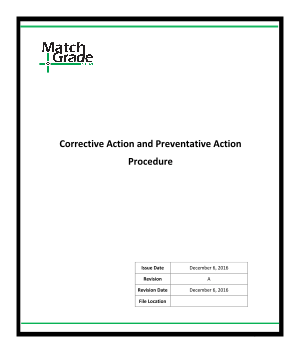
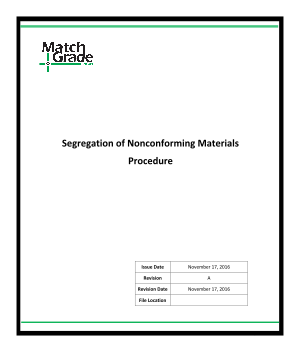
At Match Grade Medical, Eric was responsible for creating the company’s first cornerstones of a Quality System as outlined in 21 CFR Part 820. These cornerstones include Segregation of Nonconforming Materials, Corrective Action and Preventative Action (CAPA), Supplier Verification, and Product Recall. Creating the global procedures – what would be considered the highest tier in a tiered-document Quality System – included the following activities:
- Researching the language included in 21 CFR Part 820, taking note of the significant aspects of a Quality System.
- Compiling a body of available examples of each Global Procedure, and highlighting specific common steps between them to establish a baseline of compliance.
- Composing first drafts of each procedure inline with both 21 CFR Part 820 and recurring steps in the compiled examples.
- Collaborating with the company CEO to ensure necessary steps and language are included to achieve compliance. Reviewing recorded steps to ensure they reflect the actual activity of the operators.
Instructions For Use and Infographics
IFUs, infographics, and similar communications are often created by technical writers and fall under the broad blanket of ‘Technical Writing’. For the purposes of this portfolio, however, those things are housed under Multimodal Communication here.
 Eric King